Love this? Save it for later!
Share the inspiration with your friends
The loaf was gone by noon. My neighbor had knocked on the door around ten, just to borrow a cup of sugar, and I’d offered her a slice still warm from the pan. She called me two hours later to ask if I had another one hidden somewhere. I didn’t. But I made a second batch that same afternoon, and honestly? I understood the urgency.
This Classic Southern Banana Bread with Buttermilk wasn’t something I grew up eating. My grandmother made a denser, sweeter version that was more cake than bread—good, but not what I was chasing. I wanted something that felt like a real breakfast, something you could slice thick and not feel guilty about. The kind of loaf that smells so good you start hovering by the oven twenty minutes before it’s done. That’s what I set out to create, and after a few over-baked, under-flavored attempts, this is the one that stuck.
There’s a quiet trust that builds when a recipe proves itself again and again. This banana bread has done that for me. It’s become the thing I bring to brunches, the reason my kitchen smells like home on a Sunday morning, and the first recipe I send to friends who say they can’t bake. Turns out, they can. They just needed the right loaf to start with.
Why You’ll Love This Recipe
I’ve tested this recipe more times than I care to count, and every single time, it delivers. Here’s why this banana bread stands out from the rest:
- Incredibly Moist : The buttermilk works magic here. It reacts with the baking soda to create a tender crumb that stays soft for days. No dry, crumbly slices here.
- Perfectly Balanced Sweetness : It’s sweet enough to feel like a treat but not so sugary that you can’t justify a second slice with your coffee. The overripe bananas do most of the heavy lifting.
- Simple, Real Ingredients : You probably have everything you need already. Butter, sugar, eggs, flour, bananas, and buttermilk. No weird add-ins or specialty flours required.
- Foolproof for Beginners : I’ve handed this recipe to people who’ve never baked a loaf of bread in their lives, and it worked for every single one. It’s forgiving and straightforward.
- Gets Better the Next Day : This is one of those rare baked goods that actually improves overnight. The flavors meld together, and the texture becomes even more velvety. If you can wait that long.
What makes this different from every other banana bread recipe out there? It’s the buttermilk. That one ingredient transforms a good loaf into a great one. It adds a subtle tang that balances the sweetness and keeps the bread from feeling heavy. Plus, I’ve dialed in the exact ratio of wet to dry ingredients so you get that perfect dome every time. No sinking centers, no gummy streaks.
This is the kind of recipe that makes you feel like you actually know what you’re doing in the kitchen. And honestly, you will.
What Ingredients You Will Need
This recipe relies on simple, everyday ingredients that come together to create something genuinely special. The beauty is in the balance—each component has a job to do, and they all work together beautifully.
- Unsalted butter , softened (1/2 cup or 1 stick) — I always use unsalted so I can control the salt level. Let it sit out for about 30 minutes before you start.
- Granulated sugar (3/4 cup) — Just enough to sweeten without overwhelming the banana flavor. You can reduce this to 1/2 cup if your bananas are extremely ripe and sweet.
- Large eggs (2, room temperature) — Room temperature eggs blend into the batter more smoothly. If you forgot to take them out, place them in a bowl of warm water for 5 minutes.
- Overripe bananas (3 medium, mashed) — The darker the better. You want them spotted brown or even black. They should be soft and almost syrupy. That’s where the flavor lives.
- Buttermilk (1/3 cup) — The star ingredient. It adds moisture, tenderness, and a subtle tang. If you don’t have buttermilk, you can make a quick substitute by adding 1 tablespoon of lemon juice or vinegar to 1/3 cup of regular milk and letting it sit for 5 minutes.
- Vanilla extract (1 teaspoon) — Pure vanilla makes a difference here. Imitation works in a pinch, but pure adds a deeper, warmer flavor.
- All-purpose flour (1 1/2 cups) — Standard AP flour gives the best structure. Spoon it into your measuring cup and level it off rather than scooping directly, which packs it down too much.
- Baking soda (1 teaspoon) — This reacts with the buttermilk to help the bread rise. Make sure it’s fresh—test it by dropping a little into vinegar; it should fizz immediately.
- Salt (1/2 teaspoon) — Don’t skip this. Salt enhances every other flavor and keeps the bread from tasting flat.
- Optional: Chopped walnuts or pecans (1/2 cup) — I add these about half the time. They add a nice crunch and make the bread feel more substantial. Toast them lightly first for extra flavor.
I’ve made this with both white whole wheat flour and a gluten-free all-purpose blend, and both worked well. If you go the gluten-free route, add an extra tablespoon of buttermilk to compensate for the drier flour blend.
Equipment Needed
You don’t need a fancy kitchen to make this banana bread. Here’s what you’ll want on hand:
- 9×5-inch loaf pan — This is the standard size. If you use an 8×4 pan, you’ll need to bake it a bit longer. If you use a 10-inch pan, start checking it earlier.
- Large mixing bowl — For combining the wet ingredients.
- Medium mixing bowl — For whisking the dry ingredients.
- Whisk and wooden spoon or rubber spatula — A whisk for the dry ingredients, and a spatula for folding everything together. Don’t overmix, so a spatula is your best friend here.
- Parchment paper — I line my loaf pan with a strip of parchment paper hanging over the long sides. It makes lifting the bread out so much easier.
- Cooling rack — Lets air circulate around the loaf so it cools evenly and doesn’t get soggy on the bottom.
- Measuring cups and spoons — Accurate measurements matter in baking. Use dry measuring cups for flour and sugar, and a liquid measuring cup for the buttermilk.
If you don’t have a loaf pan, you can bake this in an 8×8 square pan and adjust the time to about 25-30 minutes. It won’t be as tall, but it’ll taste just as good.
Preparation Method
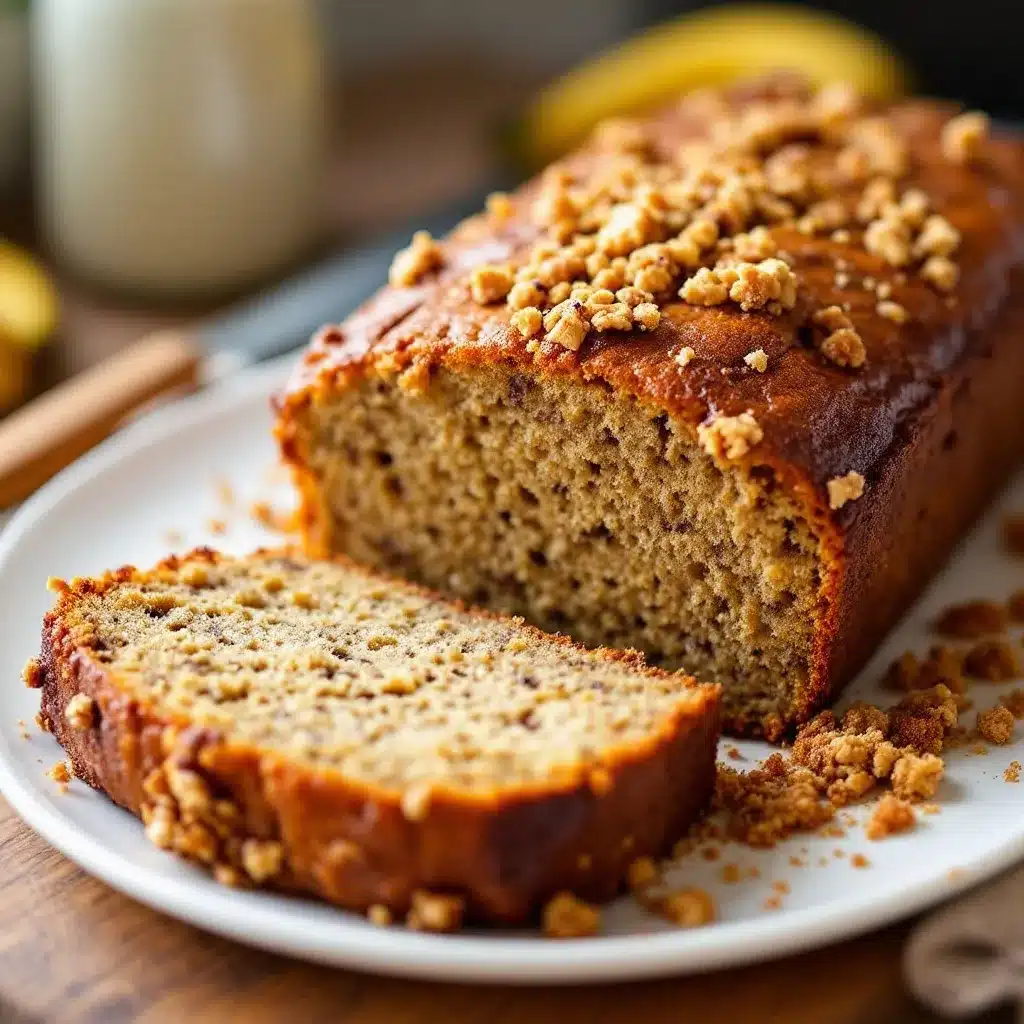
Let’s get baking. This process is straightforward, but I’ve added some notes along the way to help you avoid the mistakes I made in my early attempts.
- Preheat your oven to 350°F (175°C). Position the rack in the center of the oven. While it’s heating, grease your loaf pan with butter or nonstick spray, then line it with a strip of parchment paper. The paper should hang over the two long sides—this creates handles for lifting the bread out later.
- Mash your bananas. In a medium bowl, mash the three overripe bananas with a fork until they’re mostly smooth but still have a few small lumps. You want about 1 to 1 1/4 cups of mashed banana. Set them aside.
- Cream the butter and sugar. In a large mixing bowl, beat the softened butter and granulated sugar together until light and fluffy. This takes about 2-3 minutes with a hand mixer, or 3-4 minutes if you’re doing it by hand with a wooden spoon. You’re looking for a pale, creamy texture. Don’t rush this step—creaming properly incorporates air, which helps the bread rise.
- Add the eggs and vanilla. Crack the eggs into the butter-sugar mixture one at a time, beating well after each addition. Stir in the vanilla extract. The mixture might look slightly curdled at this point—that’s okay. It’ll come together once you add the bananas and buttermilk.
- Mix in the bananas and buttermilk. Add the mashed bananas and buttermilk to the bowl. Stir until just combined. The batter will look a little lumpy and not perfectly smooth. That’s exactly what you want.
- Whisk the dry ingredients. In a separate medium bowl, whisk together the all-purpose flour, baking soda, and salt. Whisking ensures the baking soda and salt are evenly distributed throughout the flour.
- Combine wet and dry. Gradually add the dry ingredients to the wet mixture, folding gently with a rubber spatula. Stir only until you no longer see streaks of flour. A few small lumps are fine. Overmixing at this stage will develop too much gluten and make your bread tough. If you’re adding nuts, fold them in now.
- Pour the batter into the prepared pan. Use your spatula to scrape every last bit into the loaf pan. Smooth the top gently. Give the pan a couple of light taps on the counter to release any air bubbles.
- Bake for 55-65 minutes. Place the pan in the center of the oven and bake until a toothpick inserted into the center comes out clean or with just a few moist crumbs. The top should be a deep golden brown and cracked beautifully down the middle. If the top is browning too quickly after 40 minutes, tent the pan loosely with aluminum foil.
- Cool in the pan for 10 minutes. Set the loaf pan on a cooling rack. After 10 minutes, use the parchment paper handles to lift the bread out of the pan. Transfer it directly to the cooling rack and let it cool completely before slicing. I know it’s tempting to cut into it warm, but it’ll crumble if you do. Give it at least an hour.
One thing I learned the hard way—don’t open the oven door for the first 35 minutes. The rush of cold air can cause the loaf to sink in the middle. Trust the process and let it do its thing.
Cooking Tips & Techniques
After making this recipe more times than I can count, I’ve picked up a few tricks that make a real difference.
Use a kitchen scale for accuracy. Flour is notorious for being packed differently depending on how you scoop it. One cup can vary by as much as 20-30 grams. If you have a scale, weigh your flour—180 grams per cup is the sweet spot. It makes a noticeable difference in the texture.
Don’t overmix the batter. This is the number one mistake I see people make. Once you add the flour, stir just until it disappears. Overmixing develops gluten, which gives you a tough, dense loaf instead of a tender, fluffy one. A few streaks of flour are better than a tough bread.
Let your bananas get truly ugly. I mean it. If your bananas are still yellow, they’re not ready. Put them in a paper bag with an apple overnight to speed up ripening. Or, if you’re like me and always have a bunch that’s gone too far, peel them, freeze them, and thaw them when you’re ready to bake. Frozen bananas release extra liquid, which makes the bread even more moist.
Check for doneness with a thermometer. If you have an instant-read thermometer, the internal temperature of a fully baked banana bread should be around 200-205°F (93-96°C). This is more reliable than the toothpick test, especially if you’re nervous about underbaking.
Let it cool completely. I know I said this already, but it’s worth repeating. Cutting into warm banana bread is tempting, but it’ll be gummy and fall apart. Patience pays off here. If you absolutely must have a warm slice, pop a cooled slice in the microwave for 10 seconds.
One of my biggest failures was a loaf that looked perfect on the outside but was still raw in the center. I’d pulled it out at 50 minutes because the top was so dark. Now I always use the foil tent trick and check the internal temp. Lesson learned.
Variations & Adaptations
This recipe is a great base for experimentation. Here are a few variations I’ve tried and loved:
- Chocolate Chip Banana Bread : Fold in 1/2 cup of semi-sweet or dark chocolate chips along with the flour. The chocolate melts into little pockets of richness that pair beautifully with the banana flavor. My kids fight over the slices with the most chocolate.
- Brown Butter Banana Bread : Instead of using softened butter, brown 1/2 cup of butter in a saucepan over medium heat until it turns golden and smells nutty. Let it cool slightly before creaming it with the sugar. The brown butter adds a deep, toasty flavor that’s absolutely incredible. I have another recipe for brown butter banana bread with walnuts that takes this idea even further.
- Gluten-Free Version : Substitute the all-purpose flour with a 1:1 gluten-free baking blend that contains xanthan gum. Add an extra tablespoon of buttermilk to help with moisture. It won’t rise quite as high, but the flavor is still spot-on.
- Vegan Adaptation : Use melted coconut oil instead of butter, flax eggs (1 tablespoon ground flaxseed mixed with 3 tablespoons water per egg), and a dairy-free yogurt or buttermilk alternative. The texture will be slightly denser, but it’s still delicious.
- Spiced Banana Bread : Add 1 teaspoon of cinnamon, 1/2 teaspoon of nutmeg, and a pinch of cloves to the dry ingredients. It gives the bread a warm, cozy flavor that’s perfect for fall mornings.
I’ve also made this as muffins when I wanted a portable breakfast. Pour the batter into a greased muffin tin and bake at 350°F for 18-22 minutes. You’ll get about 12 muffins. They freeze beautifully, too—just wrap them individually and grab one on your way out the door.
Serving & Storage Suggestions
This banana bread is versatile when it comes to serving. Here are my favorite ways to enjoy it:
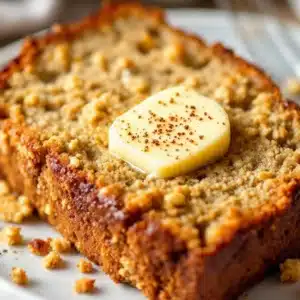
- Warm with butter : Toast a slice and spread a pat of salted butter on top. The butter melts into the warm bread, and the salt balances the sweetness perfectly.
- With a drizzle of honey : A light drizzle of honey or maple syrup adds a touch more sweetness and a lovely floral note.
- Alongside coffee or tea : This bread was practically made for a morning cup of coffee. The mild sweetness pairs beautifully with a bold brew or a creamy latte.
- As a dessert : Serve a slice with a scoop of vanilla ice cream or a dollop of whipped cream. It’s simple but feels indulgent.
For storage, let the bread cool completely, then wrap it tightly in plastic wrap or aluminum foil. Keep it at room temperature for up to 3 days. The flavor actually improves after the first day as the buttermilk and banana meld together.
To freeze, wrap the cooled loaf (or individual slices) in plastic wrap, then place it in a freezer-safe bag or container. It will keep for up to 3 months. When you’re ready to eat, thaw it on the counter for a few hours or pop a slice in the toaster straight from the freezer.
One note—if you store it in the refrigerator, the texture will become denser and drier. Room temperature is best for short-term storage.
Nutritional Information & Benefits
Here’s an approximate nutritional breakdown per slice (based on 10 slices, without nuts):
- Calories: 245
- Fat: 10g
- Saturated Fat: 6g
- Carbohydrates: 35g
- Fiber: 1g
- Sugar: 18g
- Protein: 4g
- Sodium: 210mg
This banana bread isn’t health food, but it does have some redeeming qualities. Bananas are rich in potassium and vitamin B6, which support heart health and energy metabolism. The buttermilk provides calcium and a small amount of protein. And because it’s made with real ingredients and not a box mix, you know exactly what you’re eating.
If you’re looking for a higher-protein breakfast option, this bread pairs nicely with a side of scrambled eggs or a savory cottage cheese bowl for a balanced meal. It’s also a great post-workout snack when you need something satisfying but not too heavy.
For those watching their sugar intake, you can reduce the granulated sugar to 1/2 cup without sacrificing too much sweetness, especially if your bananas are very ripe. The natural sugars in the bananas will do a lot of the work.
Conclusion
This Classic Southern Banana Bread with Buttermilk has earned its place in my regular rotation. It’s the kind of recipe that feels both special and everyday—special enough to bring to a gathering, but simple enough to whip up on a random Tuesday afternoon when you have three brown bananas staring at you from the counter.
What I love most about it is how forgiving it is. You can swap out ingredients, adjust the sweetness, add nuts or chocolate chips, and it still turns out beautifully. It’s a recipe that invites you to make it your own without demanding perfection.
I hope you give it a try. Let me know in the comments how it turned out for you—did you add anything? Change anything? I genuinely love hearing about your versions. And if you’re looking for another cozy baked good to try, my brown butter chocolate chip cookies are another favorite that uses a similar technique.
Happy baking, friends. There’s nothing quite like a warm slice of banana bread and a quiet morning.
Frequently Asked Questions
Can I use frozen bananas for this recipe?
Absolutely. In fact, frozen bananas work great because they release extra moisture as they thaw, which makes the bread even more tender. Just thaw them completely, drain off any excess liquid, and mash them well before adding to the batter.
Why did my banana bread sink in the middle?
This usually happens for one of three reasons: the oven temperature was too low, the batter was overmixed, or you opened the oven door too early. Make sure your oven is fully preheated to 350°F, mix the batter gently, and resist the urge to peek for the first 35 minutes.
Can I make this recipe without buttermilk?
Yes. If you don’t have buttermilk on hand, you can make a quick substitute by adding 1 tablespoon of lemon juice or white vinegar to 1/3 cup of regular milk. Let it sit for 5 minutes until it thickens slightly. It works perfectly as a replacement.
How do I know when the banana bread is fully baked?
Insert a toothpick or skewer into the center of the loaf. If it comes out clean or with just a few moist crumbs, it’s done. You can also use an instant-read thermometer—the internal temperature should be around 200-205°F.
Can I double this recipe?
Yes, this recipe doubles beautifully. Use two 9×5 loaf pans and bake them side by side. You may need to rotate the pans halfway through baking to ensure even browning. The baking time will be about the same, but start checking at 50 minutes.
Pin This Recipe!
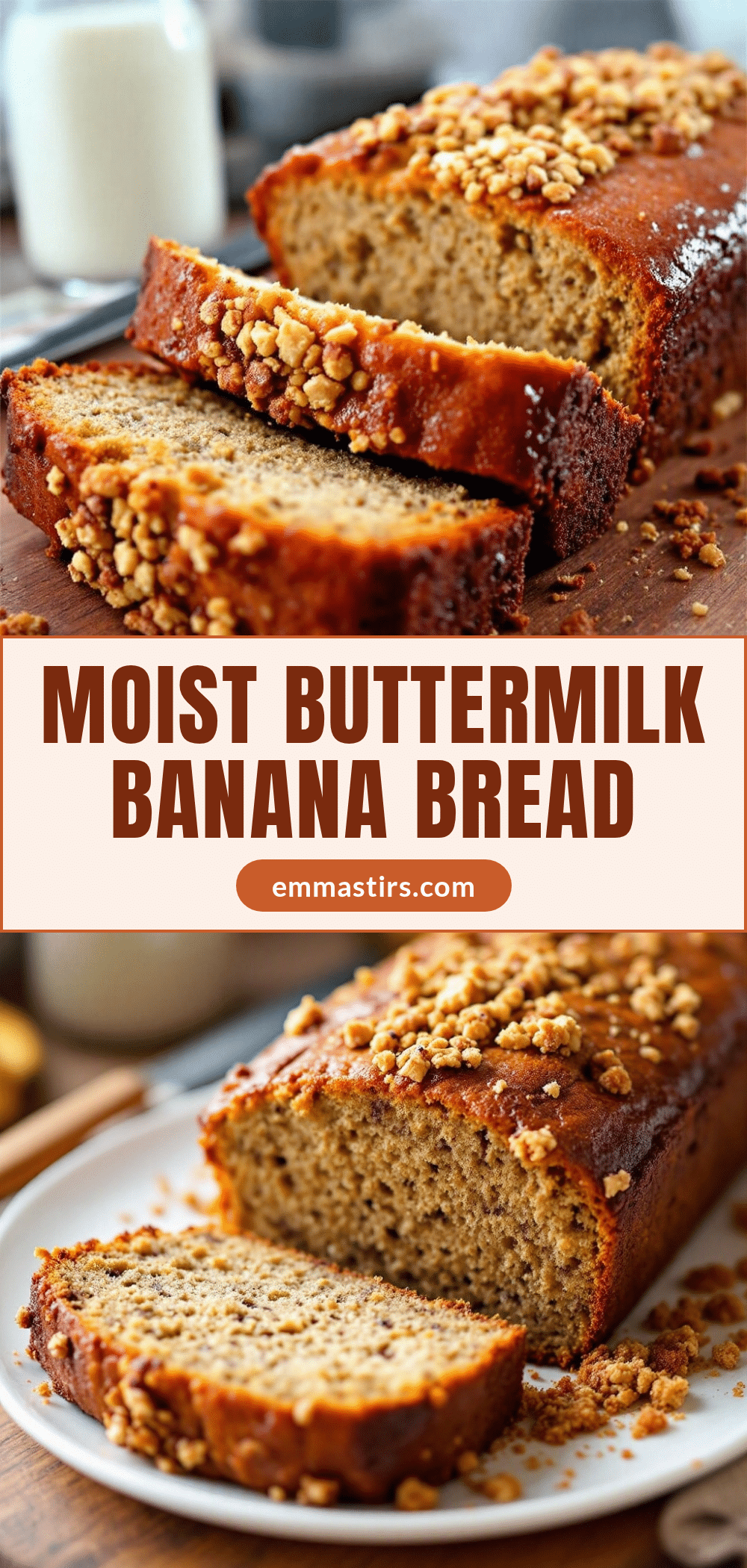
Classic Southern Banana Bread with Buttermilk
This incredibly moist and perfectly sweet banana bread uses buttermilk for a tender crumb and subtle tang. It’s a foolproof recipe that gets better the next day, making it the perfect breakfast or snack.
- Prep Time: 15 minutes
- Cook Time: 60 minutes
- Total Time: 1 hour 15 minutes
- Yield: 10 servings 1x
- Category: Bread
- Cuisine: Southern
Ingredients
- 1/2 cup (1 stick) unsalted butter, softened
- 3/4 cup granulated sugar
- 2 large eggs, room temperature
- 3 medium overripe bananas, mashed (about 1 to 1 1/4 cups)
- 1/3 cup buttermilk
- 1 teaspoon vanilla extract
- 1 1/2 cups all-purpose flour
- 1 teaspoon baking soda
- 1/2 teaspoon salt
- 1/2 cup chopped walnuts or pecans (optional)
Instructions
- Preheat your oven to 350°F (175°C). Grease a 9×5-inch loaf pan with butter or nonstick spray, then line it with a strip of parchment paper hanging over the long sides.
- In a medium bowl, mash the bananas with a fork until mostly smooth with a few small lumps. Set aside.
- In a large mixing bowl, beat the softened butter and sugar together until light and fluffy, about 2-3 minutes with a hand mixer or 3-4 minutes by hand.
- Add the eggs one at a time, beating well after each addition. Stir in the vanilla extract.
- Add the mashed bananas and buttermilk to the bowl. Stir until just combined.
- In a separate medium bowl, whisk together the flour, baking soda, and salt.
- Gradually add the dry ingredients to the wet mixture, folding gently with a rubber spatula until no streaks of flour remain. If using nuts, fold them in now.
- Pour the batter into the prepared pan and smooth the top. Tap the pan lightly on the counter to release air bubbles.
- Bake for 55-65 minutes, until a toothpick inserted into the center comes out clean or with a few moist crumbs. If the top browns too quickly, tent with foil after 40 minutes.
- Cool in the pan for 10 minutes, then use the parchment paper to lift the bread out and transfer to a cooling rack. Cool completely before slicing.
Notes
For best results, use overripe bananas (spotted brown or black). Do not overmix the batter. Let the bread cool completely before slicing to prevent crumbling. Store at room temperature for up to 3 days or freeze for up to 3 months.
Nutrition
- Serving Size: 1 slice
- Calories: 245
- Sugar: 18
- Sodium: 210
- Fat: 10
- Saturated Fat: 6
- Carbohydrates: 35
- Fiber: 1
- Protein: 4
Keywords: banana bread, buttermilk banana bread, southern banana bread, moist banana bread, easy banana bread